In town
The old prison
Maritime and Prison Museum
- Opens10:00 to 20:00
- Allow2 hours
- TicketValid 2 days
Explore the stops
The short version
The End of the World Train began as a convict railway: prisoners of Ushuaia's jail laid it to haul timber and stone, it fell silent when the prison closed, and it was later revived as a heritage ride for visitors.
History facts
Discover 20 stops
Select a route, then press a pin or stop to read its note and open Google Maps.
The convict-built prison, now the Maritime and Prison Museum; open 10:00 to 20:00.
Google MapsCapital of Tierra del Fuego province, at the southern tip of Patagonia.
Google MapsMain station on Route 3 at km 3065, about 8 km from the centre; the only place to board.
Google MapsThe halfway stop: about 20 minutes off the train, with a gazebo over the Pipo valley.
Google MapsEnd of the line inside the national park; the train waits 10 to 15 minutes before heading back.
Google MapsFree camping area in the Pipo valley and start of the waterfall trail; the tracks run close by.
Google Maps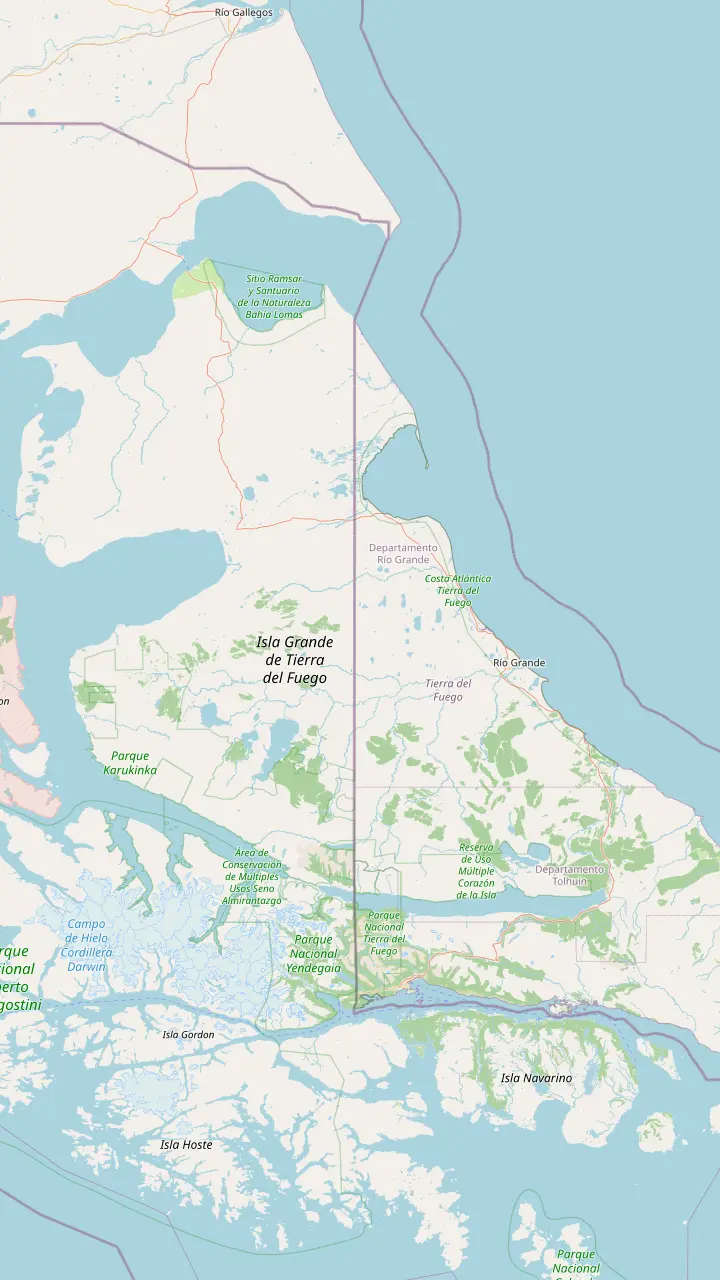
Capital of Tierra del Fuego province, at the southern tip of Patagonia.
Google MapsAirport 5 km from town; no public transport into the centre.
Google MapsWhere National Route 3 ends; the sign gives 3,063 kilometres to Buenos Aires.
Google MapsChilean town on Navarino Island that Chile's tourism board calls the southernmost city.
Google MapsA binational lake, like Acigami, crossed by the Chilean border.
Google MapsThe island's northern city; its airport lies about 5 km north-west of the centre.
Google MapsThe ferry crosses the Strait of Magellan, Chilean water, on the road to the island.
Google Maps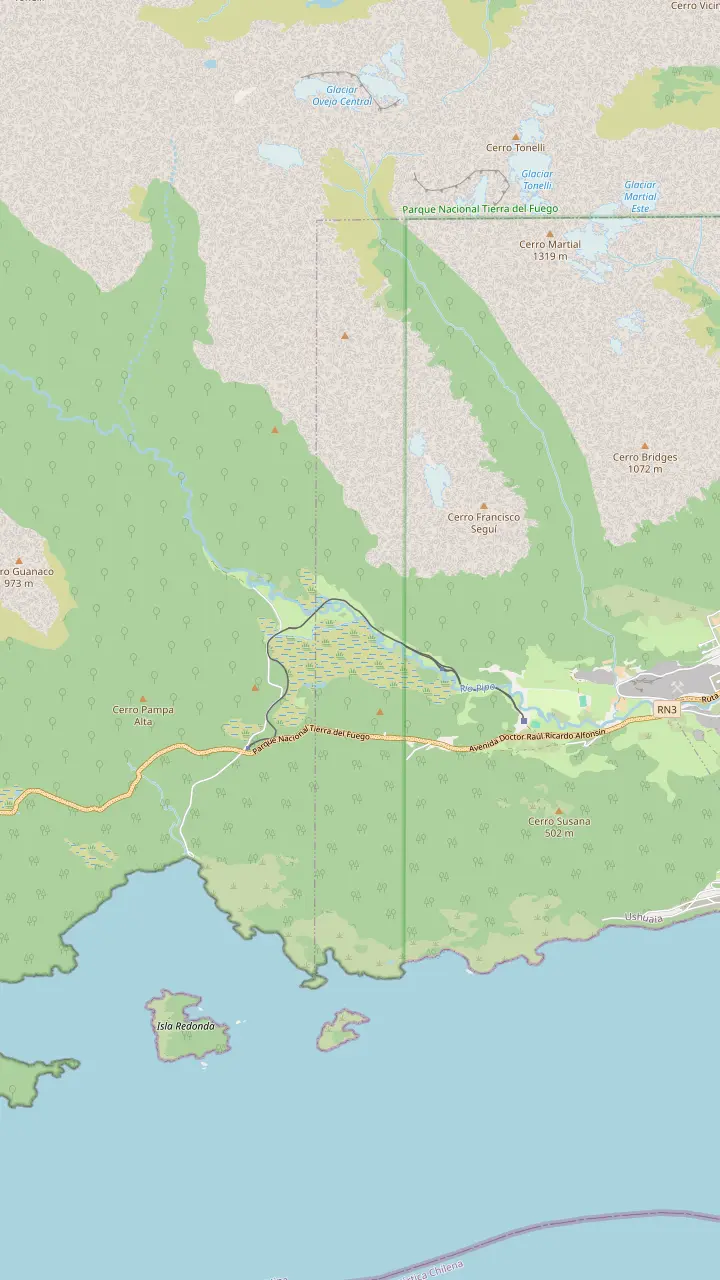
Main station on Route 3 at km 3065, about 8 km from the centre; the only place to board.
Google MapsThe halfway stop: about 20 minutes off the train, with a gazebo over the Pipo valley.
Google MapsThe waterfall where the prisoners' locomotive once took on water.
Google MapsFree camping area in the Pipo valley and start of the waterfall trail; the tracks run close by.
Google MapsWaterfall trail of 30 minutes and 931 m, open November to April.
Google MapsEnd of the line inside the national park; the train waits 10 to 15 minutes before heading back.
Google Maps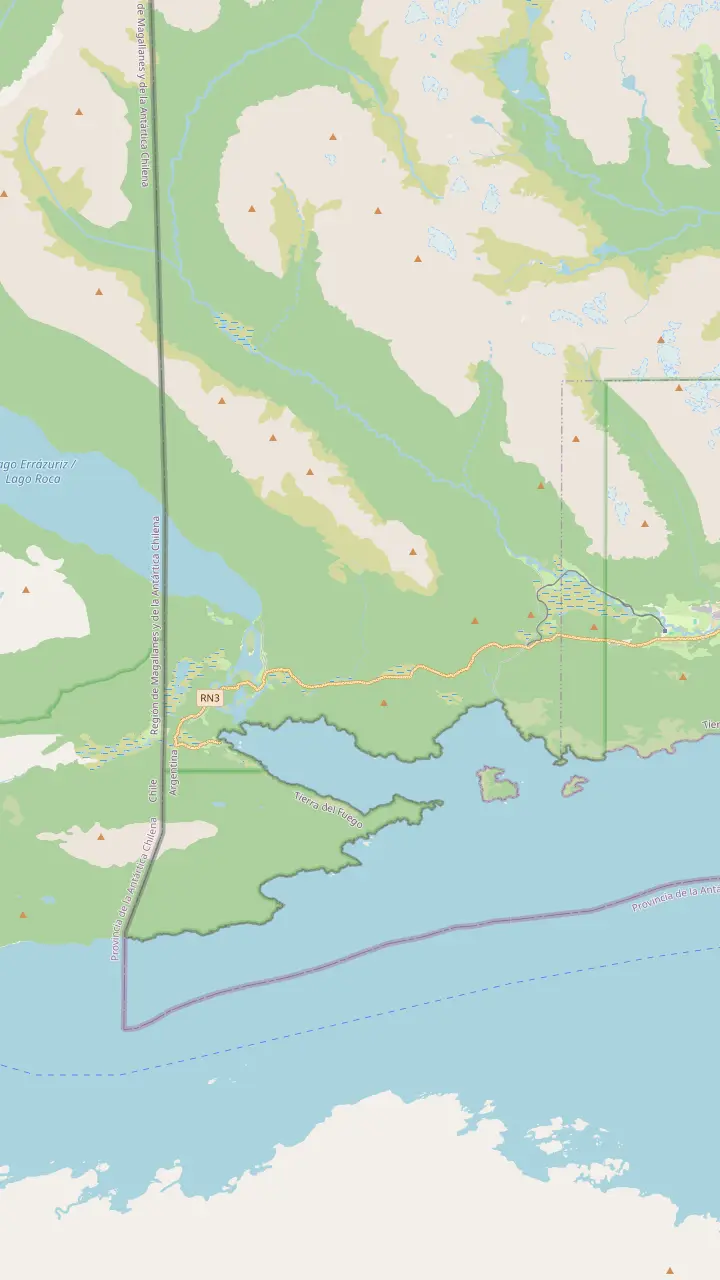
End of the line inside the national park; the train waits 10 to 15 minutes before heading back.
Google MapsCoastal site facing Isla Redonda and start of the Coastal Path.
Google MapsVisitor centre whose restaurant and café open from 10 to 17:30.
Google MapsLake Acigami, also called Roca, a binational lake crossed by the Chilean border.
Google MapsWhere National Route 3 ends; the sign gives 3,063 kilometres to Buenos Aires.
Google MapsLaguna Verde, on Isla Entre Ríos, is one of the park's basic campsites, without services.
Google MapsShort path to an old beaver dam: 20 minutes, 200 m, open all year.
Google MapsHigh-difficulty climb: 7:30 hours and 5 km return, open November to April.
Google MapsWaterfall trail of 30 minutes and 931 m, open November to April.
Google Maps© OpenStreetMap contributors · map data
End of the World Train history starts with a prison: convicts laid the first rails to haul timber and stone for a jail they were building themselves. Here is how that line became today's ride.
Editorial team, endoftheworldtrain.com · Updated November 11, 2026 · Takes 8 min
Basics
End of the World Train history makes sense only once you see what Ushuaia was before the rails. The first people on these shores were the Yamana, a canoe people who for thousands of years lived mainly by hunting sea lions, according to the train operator's own history page.6 The Argentine state arrived late: the city's tourism office dates the founding of the Ushuaia Subprefecture to 12 October 1884.7 For years after that the settlement stayed tiny and hard to reach.
The answer Buenos Aires chose was a prison. On 3 January 1896 the interim president, Julio Roca, signed Decree 3335 to set up a penal colony in Tierra del Fuego, the Maritime Museum records.8 The operator sums up the thinking plainly: a penal colony would help populate the island and assert Argentine sovereignty in the far south.1 Prisoners were to be the labour force.
There was already a military prison on Isla de los Estados, the rocky island east of Tierra del Fuego. The museum says it was moved to Ushuaia in 1902 for humanitarian reasons, at a time when the town had some 40 houses.9 A first plan imagined a penal colony for 580 inmates at Lapataia Bay, with some 2,500 hectares reserved near the Chilean border.10 That colony never took shape, but the prison in town did, and it needed wood.
Then and now
| Prisoners' train | Today's train | |
|---|---|---|
| Purpose | Timber, stone and goods | Heritage ride for visitors |
| Length | Over 22 km at its peak | 7 km route |
| Gauge | 600 mm | Narrow gauge |
| Starts | At the prison in town | Main station on Route 3 |
| Early power | Oxen, then steam | Locomotives kept by the workshop |
Old line from the Maritime and Prison Museum; today's route from the operator.22,3,23,24,25,26
The foundation stone of the Ushuaia prison was laid on 15 September 1902.12 Construction was directed by engineer Catello Muratgia and carried out by the convicts themselves, using stone, mortar, timber and metal sheeting.13 The museum dates the finished National Prison to 1920 after years of building by prison labour.14 Every block of stone and every beam had to be cut, carried and lifted at the edge of the Beagle Channel.
By 1920 the building had 5 pavilions with 76 outward-facing cells each.15 The 386 cells were made for a single prisoner, yet at one point the penitentiary held some 600 inmates.16 The most dangerous convicts lost their names and were known by a number.17 Some inmates became notorious in Argentina, among them Mateo Banks, Cayetano Santos Godino and the anarchist Simón Radowitsky, whose stories the museum still tells.18
The prison also ran much of the young town. Its 30 work sectors included several outside the walls, the museum says.19 Prison workshops gave Ushuaia its first printing press and its telephone, electricity and fire services.20 Prisoners with good behavior worked outside the building, logging in forests they reached by train from the town centre.21 That last detail is the seed of the railway you ride today: a prison needed fuel and timber, and the forest was miles away.
The first line was barely a railway at all. The museum describes wooden rails, a line nicknamed the Xylo-carril, and small wagons pulled by oxen.22 Prison director Catello Muratgia asked to buy proper Decauville track to move rock and firewood faster, and until that material arrived in 1908 the wooden rails and oxen did the work.2 It must have been slow, muddy going on the forest slopes above the bay.
Steam came with metal track. A decree of 1911 cleared the way to buy a 25-HP steam locomotive together with 3,000 m of rail and six wagons of different kinds.31 The museum's Spanish page adds that the purchase of the Decauville train was authorized in 1913.32 Old photographs show an Orenstein & Koppel and a Jüng locomotive, which the museum thinks date from 1910 and 1928.33 The museum's own pages give 1910 and 1913 as the years the convict line opened, so treat any single date with care.34,35
Whatever the opening year, the gauge was narrow. The prisoners' train ran on a 600-mm gauge, owned by the Ministry of Justice and its prison service.3 Its job was to carry wood and stone and to move goods between the pier and the prison.3 Today's End of the World steam train keeps that toy-like scale, which is part of its charm: the coaches feel small, the locomotive close enough to hear every beat of its exhaust.
Plan your history day
Pick the stop that matches how deep you want to go.
If I want the full prison story
The museum in town
Its pavilions keep the cells, plus the maritime and Antarctic collections.27
If I love old machines
The station workshops
The workshops repair engines and boilers; visits depend on operations.26,28
If I want history with scenery
The train ride itself
The audio guide tells the prisoners' story stretch by stretch.29
If I have children with me
Ride, then the museum
Under 12s with an adult enter the museum free.30
Where the story lives
In town
Maritime and Prison Museum
Start of the ride
Main station, Route 3
Halfway stop
Waterfall on the line
The prison railway was far longer than the tourist ride. The museum says its length changed over time and reached more than 22 km, while its prison history page gives 25 km.23,66 It ran alongside Maipú street, passed the camp at Monte Susana and split into branches toward what is now the national park.66 From 1908 the network climbed the slopes of Cerro Susana, entered the Pipo valley and reached the Cañadón del Toro, now inside the park.67
The city tourism office describes the same purpose in simpler words: the train left the prison for the slope of Susana Mountain to fetch wood and stone for building.68 The national park service lists timber extraction works near the Beagle Channel from the early twentieth century until 1960 among the park's historic sites.69 Riding the line today, you cross the same valley where convict crews once felled and loaded logs.
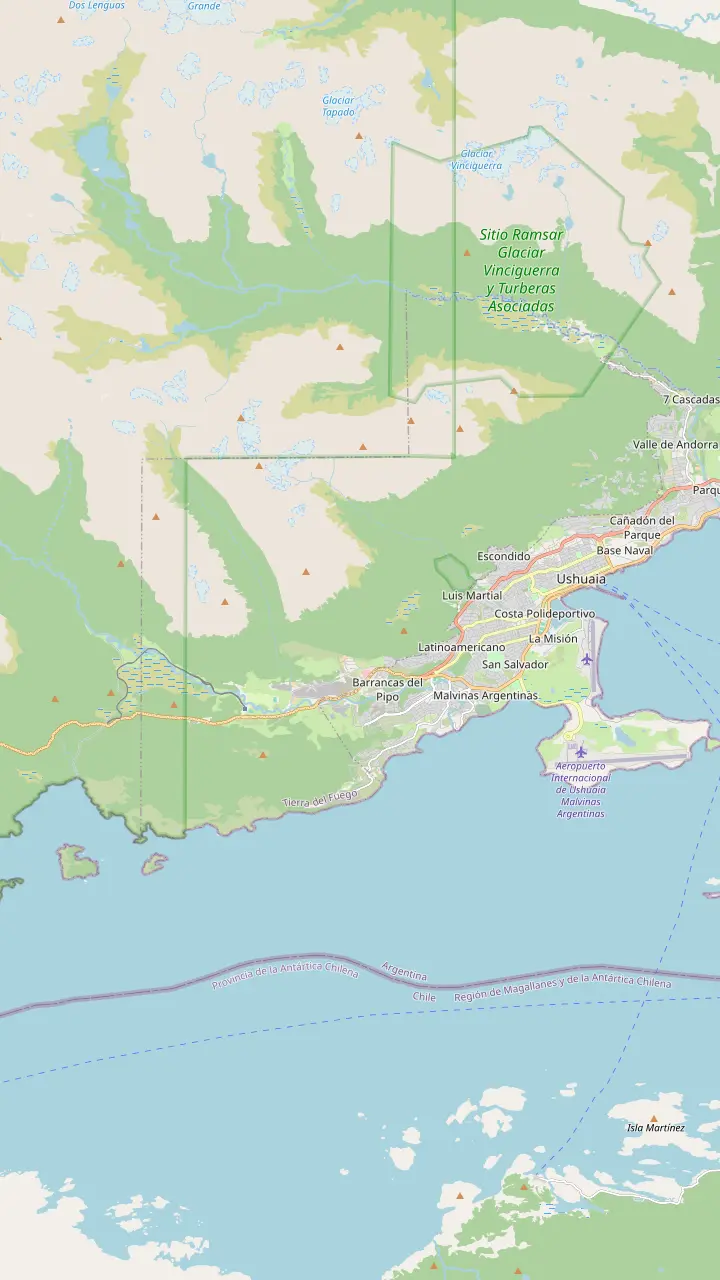
The map on this page shows the old prison in town, the End of the World railway in Ushuaia's western valley, and the stations of the modern ride. The operator says the tourist train recreates the last kilometres of the historic prisoners' line.70 So the 7 km you ride today are a short piece of a much longer network that once began on the town's streets.24 The rest of the old trackbed has long since gone back to forest or under the growing city.
From colony to tourist ride
1884
Argentina sets up a permanent naval base on the channel.11
1896
Decree 3335 plans a penal colony on the island.8
1902
The foundation stone is laid on 15 September.12
1908
Decauville track replaces wooden rails and oxen.2
1947
Closed on 21 March by presidential decree.4
1994
The route is recovered as a tourist ride.5
The museum keeps a remarkable memory of the line in snow. Alfonso Lavado, a man born and raised in Ushuaia, recalled that the prison guards came in at 6 in the morning because at 7 the convicts left by train.71 In winter a work gang of 50 or 60 men walked ahead with shovels, clearing the track while the little train crept behind them.71 It is a vivid picture of how the forest was reached in the cold months.
The same account says that around kilometre 5 or 8 there were ravines where the convicts dug tunnels through the snow.72 Only the well-behaved prisoners went out to work, he remembered, while the others stayed inside cleaning and painting a jail kept spotless. Prisoners prepared firewood in winter and summer alike, a reminder that the whole town depended on the fuel this line brought down from the slopes.
Engines changed too. In the same memory the first engine was a small machine that lasted about 25 years, followed by a bigger one on a slightly wider gauge that could carry more cargo.73 When you ride in July past snowbanks along the Pipo, think of those crews digging the line open by hand. The national park still counts the stories of the train and of convict escapes as part of its intangible heritage.74
Video
MARCUS VALE - The Vanished States on YouTube · The video stays unloaded until you press play.
It is known that it used to have wooden rails and was called Xylo-carril (wooden railway). Its small wagons were pulled by oxen
Before the museum
The prison closed on 21 March 1947 by a presidential decree of Juan Domingo Perón.4 The operator's history ties the end of the prisoners' train to the same closure, after decades as part of daily life in Ushuaia.75 The buildings passed to the navy, and a naval base was set up in them in 1950.76 With no convicts to haul timber, the rails had no purpose, and for years the line lay quiet.
The revival came from private hands. The operator dates a new stage to 1994, when the historic route began to be recovered as a tourist and heritage ride.5 Its history page names Enrique Quique Díaz as the key driver of that initiative.77 Since 2017 the company has been run by new owners of local origin.78 After more than 30 years the operator calls the train a key part of Ushuaia's tourism.79
The prison building was saved too. It was declared a National Historic Monument by law in April 1997.80 Today its pavilions house a maritime museum, an Antarctic museum and a gallery of marine art.27 The city's tourism office calls the old jail, built by the prisoners themselves, a living heritage of Tierra del Fuego.46 Together, the museum and the train tell the same story from both ends of the old line.
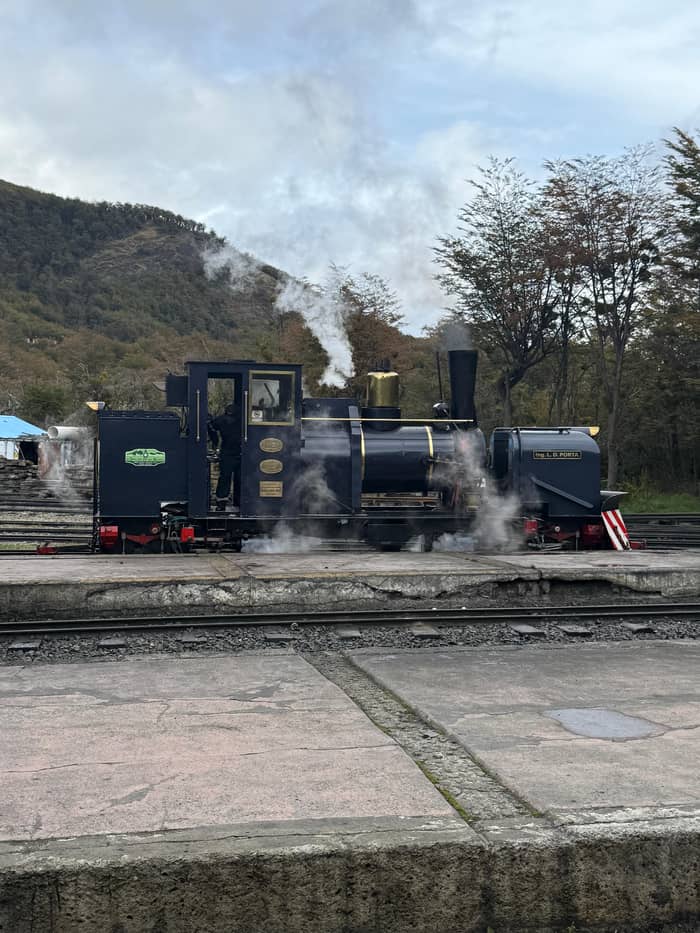
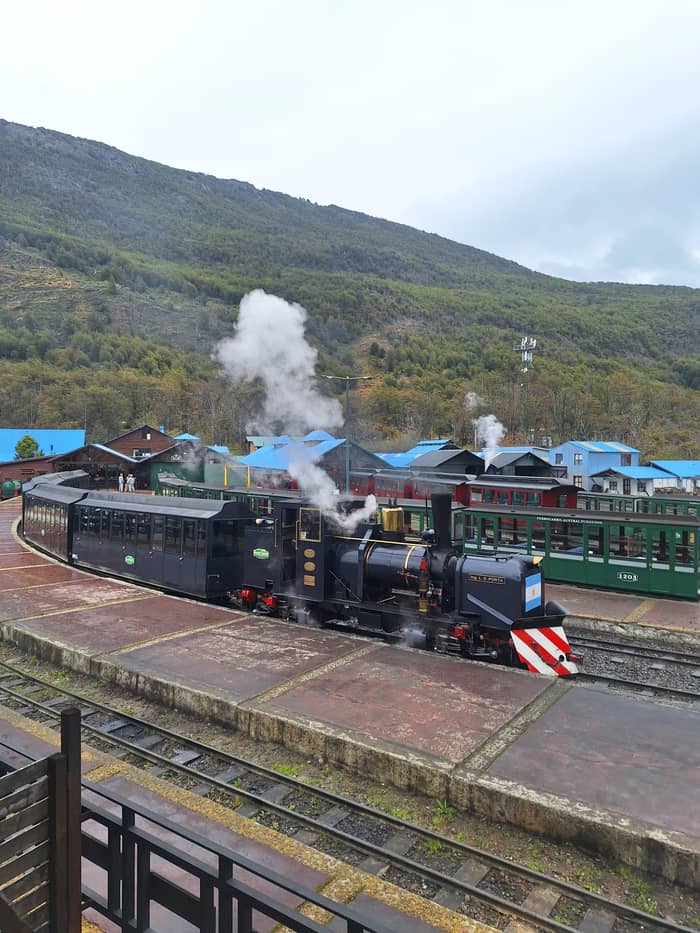
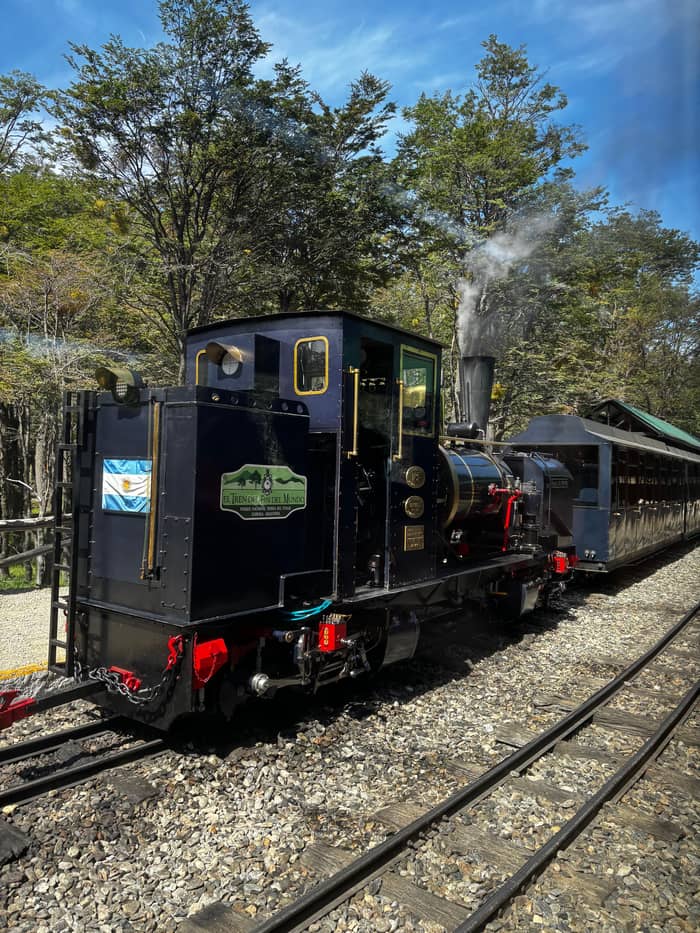
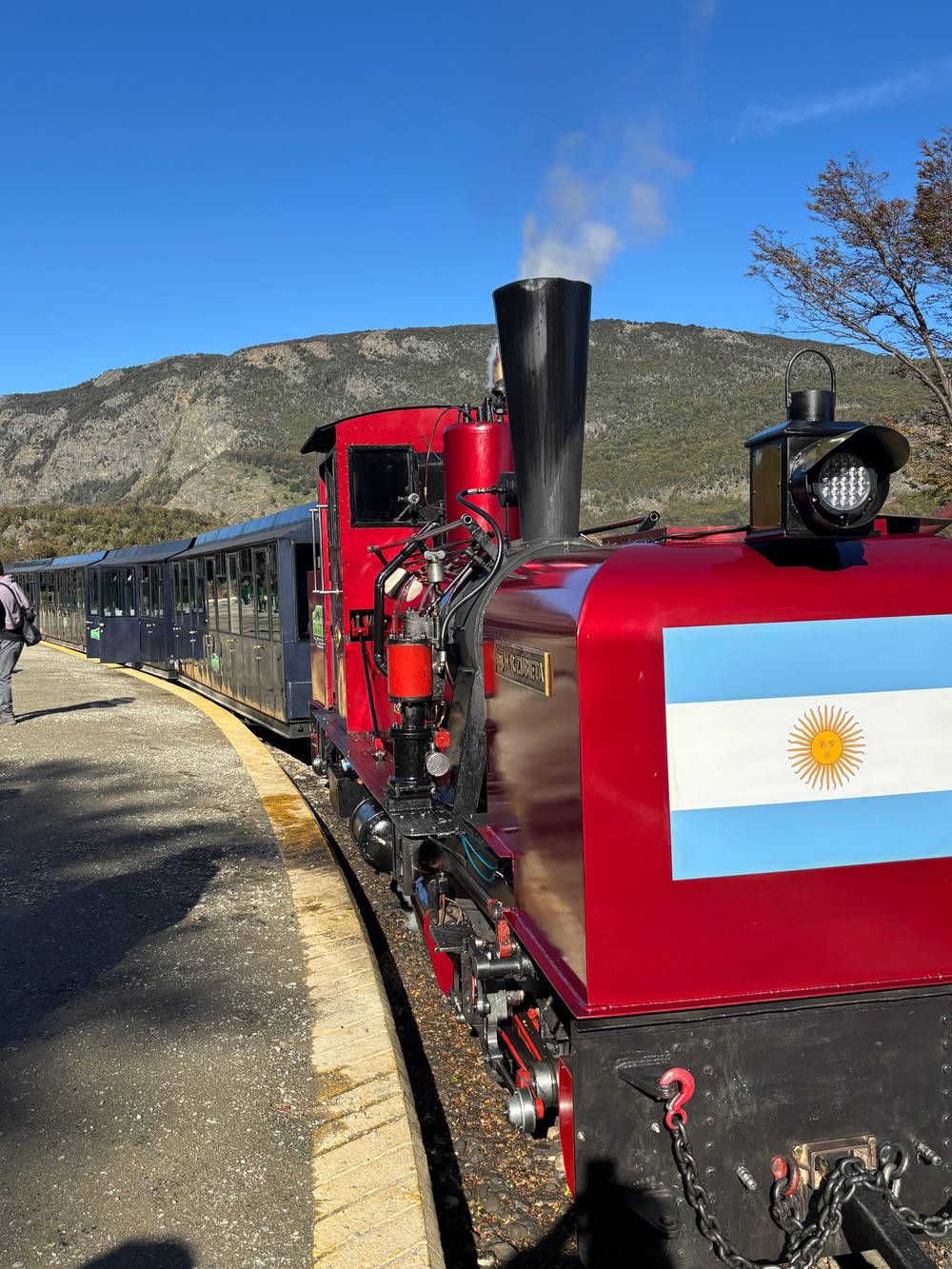
Start at the station. The city tourism office says the End of the World Station displays the maintenance workshops and old photographs, with a gift shop and café while you wait.81 Its workshops repair and tune engines, boilers and every system the locomotives need.26 The operator's photographs show locomotives named Camila and Zubieta at the park station and Porta at La Macarena.82,83,84 A workshop visit is possible only when operations allow it.28
On board, the history becomes the commentary. A recorded guide in 10 languages tells the convicts' story section by section.29 At La Macarena, the stop beside the waterfall where the prisoners' locomotive once took on water, recent works added a locomotive with hoppers as an open-air walk through railway history.39,85 Look at the forest along the way with the convicts in mind, and imagine the same slopes cleared by hand for firewood.
Finish in town at the old prison. The Maritime and Prison Museum opens from 10:00 to 20:00, and adult tickets cost ARS 50,000 from 1 October 2026.47,86 The ticket is valid for 2 days in a row and is sold only at the museum.63 The museum recommends allowing 2 hours.64 Children under 12 with an adult go in free, which makes it an easy family pairing with the ride on the same day or the next.30 Leave big bags at your hotel, since the museum turns away luggage and large backpacks.87
FAQ
The museum says convict labour built the southernmost train, used to haul timber and stone.34
The operator ties the end of the prisoners' line to the prison's final closure in 1947.75
The museum gives the prisoners' line a 600-mm gauge.3
The operator dates the recovery of the route as a tourist ride to 1994.5
The first wagons ran on wooden rails and were pulled by oxen.22
Sources
Related guides
Riding the old prison line into the park? Ask a real person here.